Help Me Decide
Helping customers make the right choices, helping the business too.
Team Specifics
Role: UX Designer
Duration: 4 months
Team: Marketing, Product Manager, Content Strategist, Developer
Tools: Sketch, InVision, User Research, Behavioral Economics Framework
Categories: UX Strategy | Behavioral Economics | User Research | Decision Architecture
Context
BBVA customers tended to default to our free checking account option because the label "free" seemed most appealing. However, their lifestyle may have been better suited by a different bank account. Due to the similarities of the bank accounts we offer, this tool was created to help customers select the bank account that is most congruent with their lifestyle.
Business Challenge:
Marketing needed a way to guide customers to optimal accounts without appearing pushy while addressing a critical revenue problem: customers selecting free checking were costing BBVA millions in lost deposits from higher-value account options.
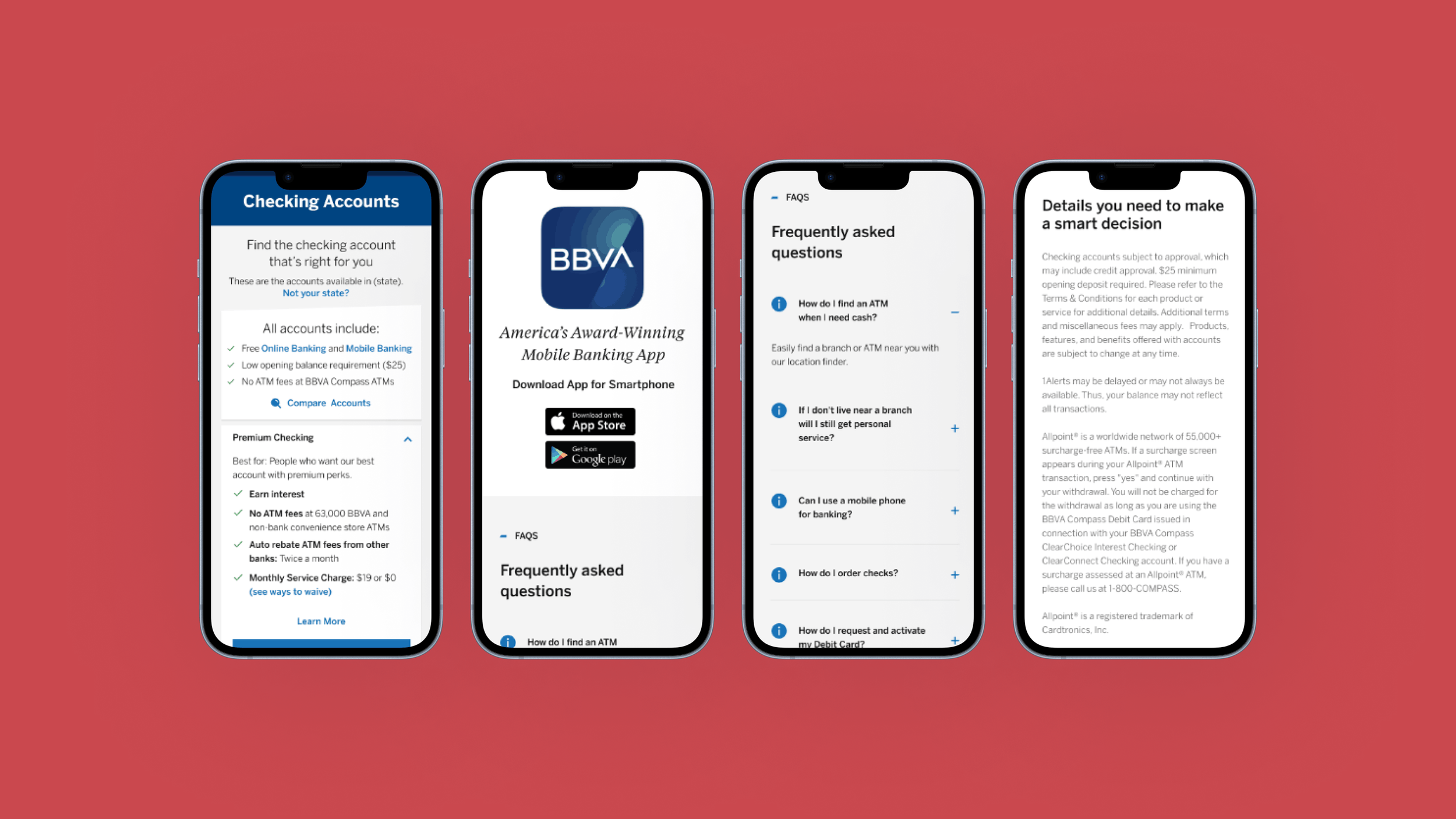
Original design: Cognitive overload lead to customers choosing the free checking account.
Problem
Very Similar Accounts
While organizing our accounts, we noticed that many of them looked similar. These similarities made it difficult for customers to make a decision on which account would provide the best fit for their needs.
The "Free" Problem
Our marketing team asked us to help our customers choose the account that would best fit their needs. Initially the solution seemed simple; we would show the customer accounts that we have and they would intuitively choose the right one. However, we discovered that most users ignored all other accounts once they saw "free" and immediately signed up for the free checking option, which led to BBVA losing millions of dollars in deposits.
Technical Constraints
Most customers selected free checking immediately upon seeing "free" label
Many customers were better suited for interest-bearing or cashback accounts.
Standard comparison tables overwhelmed customers with too much information at once.
Challenge
The word "free" was psychologically magnetic—customers defaulted to free checking immediately, costing BBVA millions in lost deposits from higher-value accounts. BBVA's checking accounts looked nearly identical; differences that mattered were buried in fine print. Comparison tables overwhelmed customers.
Had to guide them to better-fit accounts without dark patterns or manipulation. Marketing wanted to "nudge" customers toward higher-value accounts, but the solution had to feel like a helpful service, not a sales tactic. Any guidance had to be transparent and tied to customers' stated needs.
Research & discovery
Behavioral Economics Foundation
Researched loss aversion, choice architecture, and decision fatigue principles to understand how to guide customers without forcing decisions.
Competitive Analysis
Reviewed 6 major banks' account selection flows. Most relied on comparison tables or lengthy forms. Few used guided, progressive experiences that reduced cognitive load.
User Research Insights
Through user testing and analytics, we found customers:
Felt overwhelmed by comparing multiple similar accounts at once
Didn't understand the practical differences between account types
Defaulted to "free" as a safe choice when uncertain
Wanted guidance but didn't trust pushy sales tactics
Design Principles:
Progressive disclosure to reduce overwhelm
Guided experience based on user needs, not bank priorities
Clear value communication without hiding the free option
Mobile-first responsive design for all device types
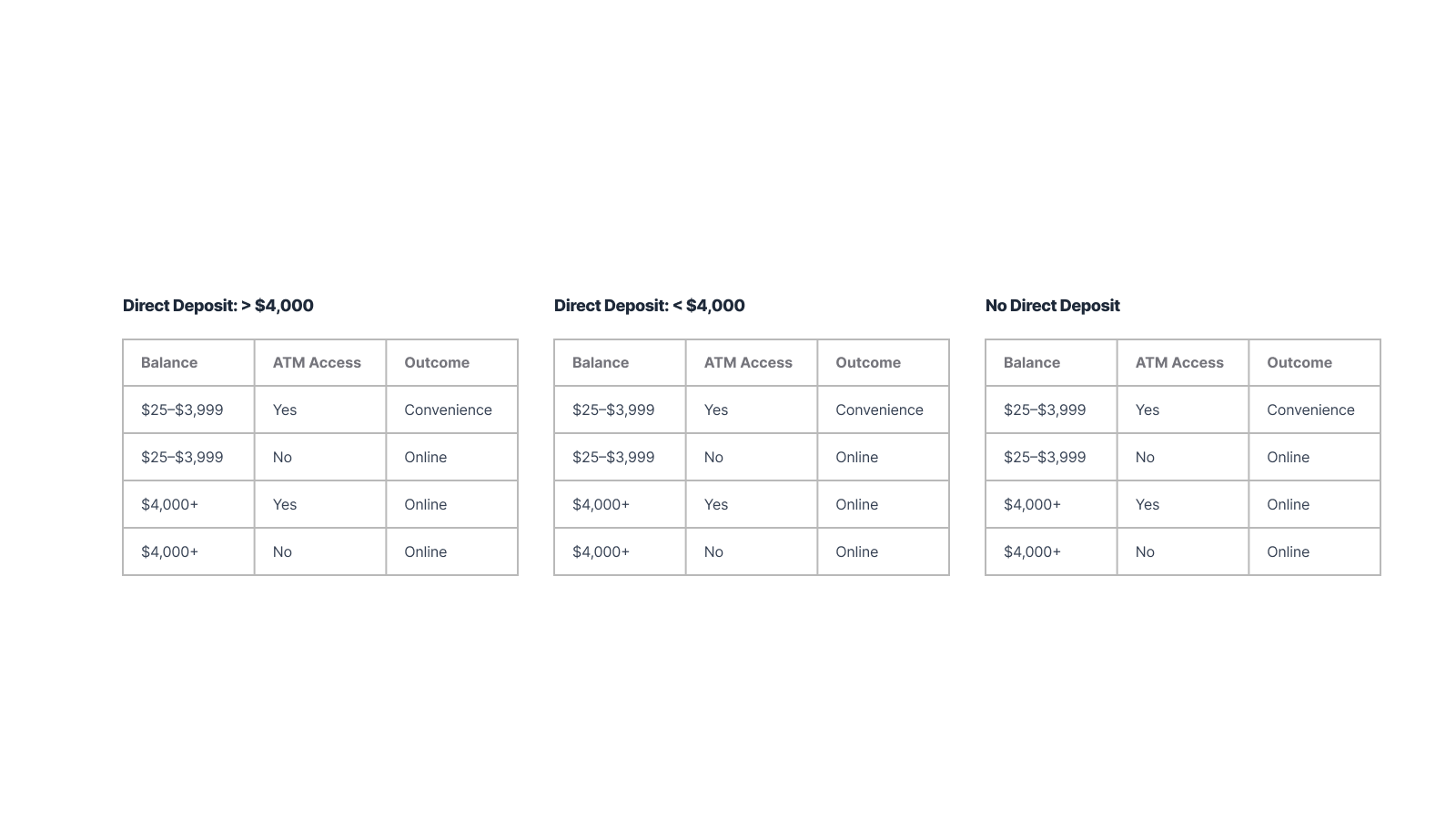
Decision Matrix: 3 accounts 6 different paths.
Solution
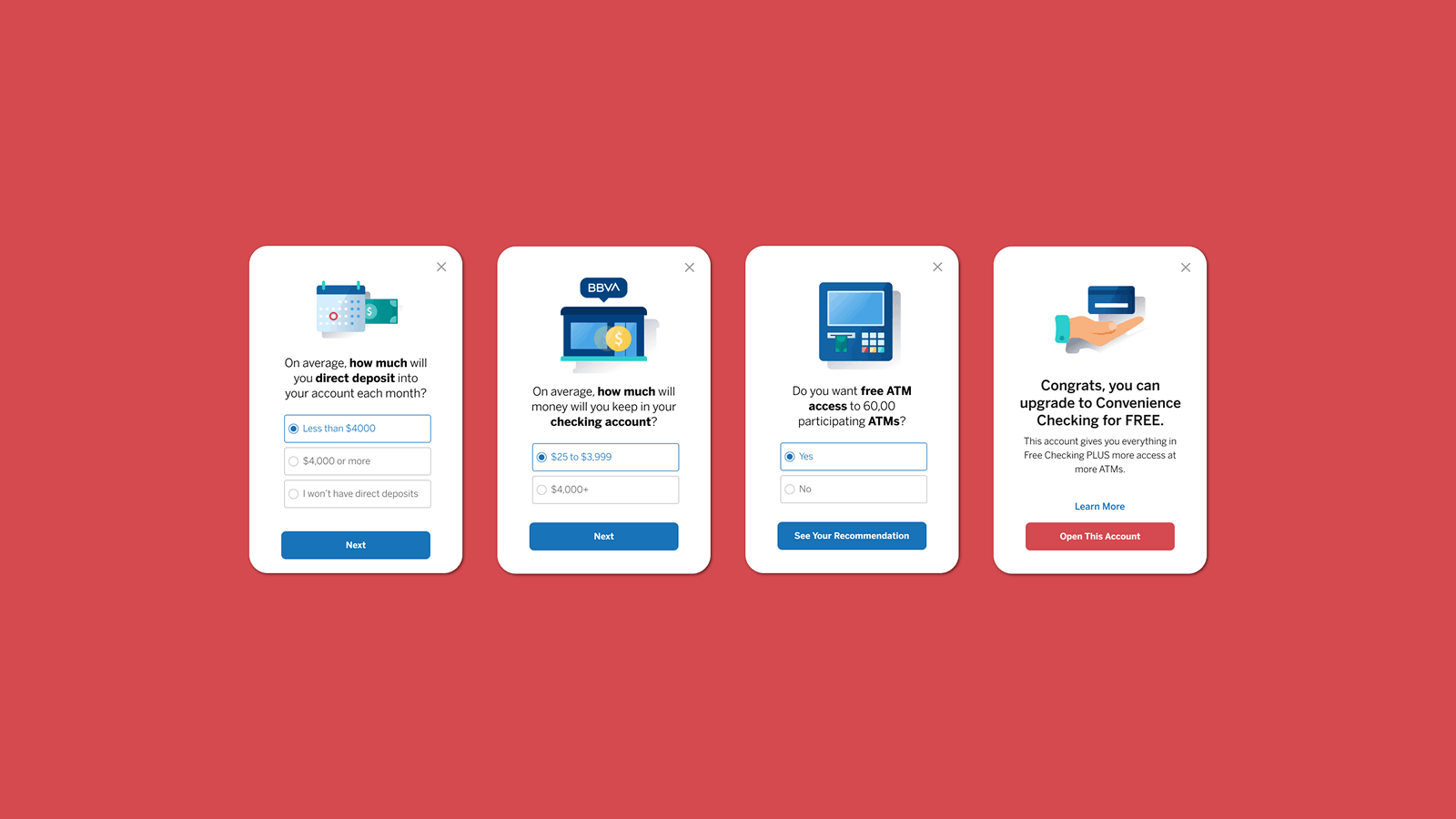
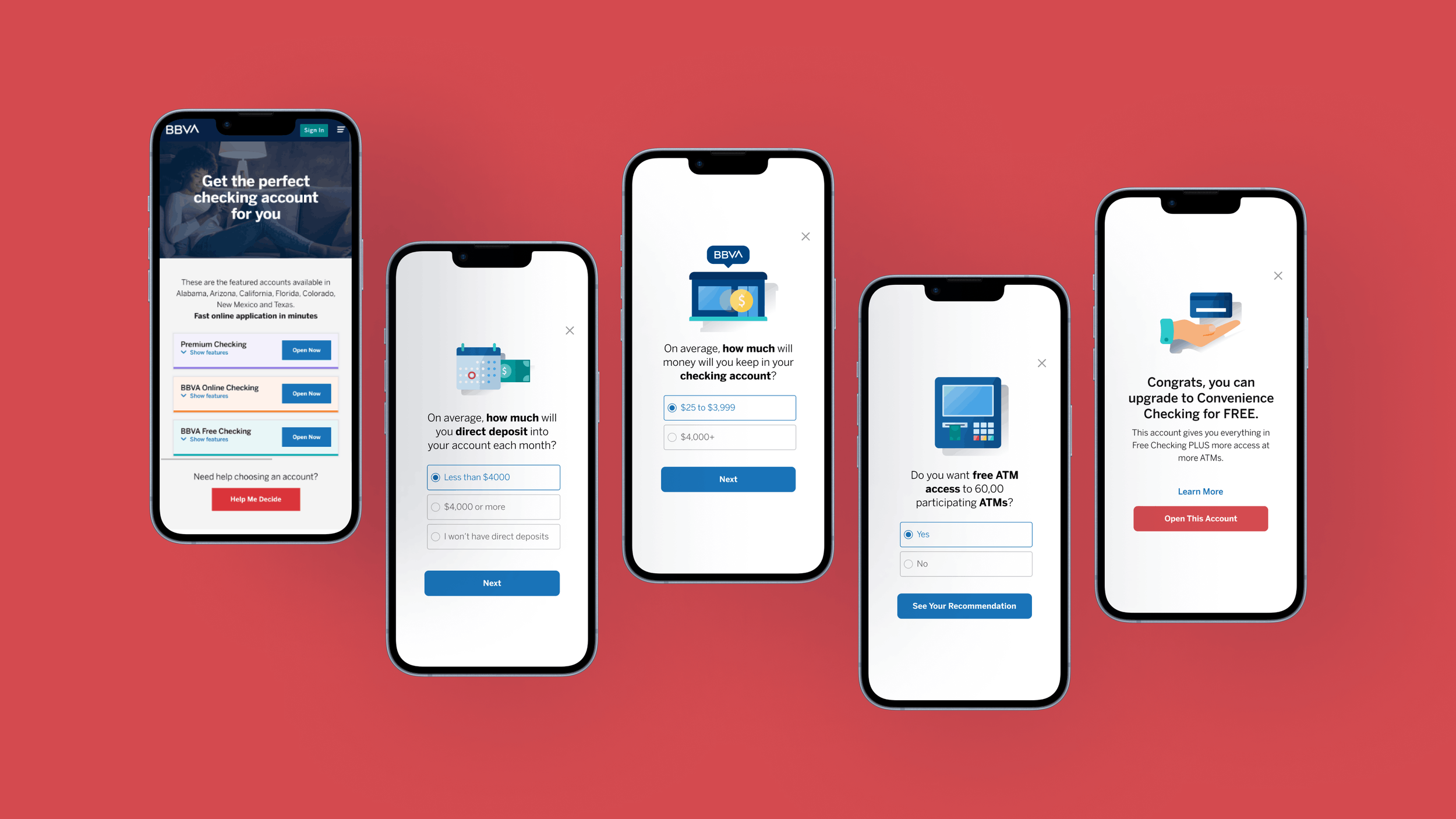
Our team created the Help Me Decide modal considering these challenges in order to streamline the customers' decision-making process. This tool allowed the customer to go through three simple prompts to narrow down their choices to the 3 bank accounts that would best fit their lifestyle.
Design Approach:
Created a 3-step progressive questionnaire that felt conversational, not interrogative
Used clear, jargon-free language to explain account differences
Showed personalized recommendations based on customer inputs
Maintained transparency by allowing users to see all options afterward
Designed mobile-optimized interface for seamless experience across devices
The modal guided customers through questions about:
Their average monthly deposit
Their typical account usage patterns
Their preferences for account features and benefits
Based on their responses, the tool recommended the top account matched to their needs, with clear explanation of why the account was suggested.
Help me Decide modals
Results
Business Impact:
The Help Me Decide Tool has been recognized by some of the best in Behavioral Economics and has contributed to a lift of more than $2.7 million in annual incremental value to BBVA USA.
Conversion & Engagement:
Increased selection of higher-value accounts
Reduced decision-making time significantly
Improved mobile completion rates across all device types
User Experience Improvements:
Customers felt more confident in their account choice
Reduced cognitive load through progressive disclosure
Maintained trust by keeping free checking visible as an option
Created reusable pattern for other product selection flows
Recognition:
Featured in behavioral economics case studies and industry publications for effective application of choice architecture and decision science.
See it live here.
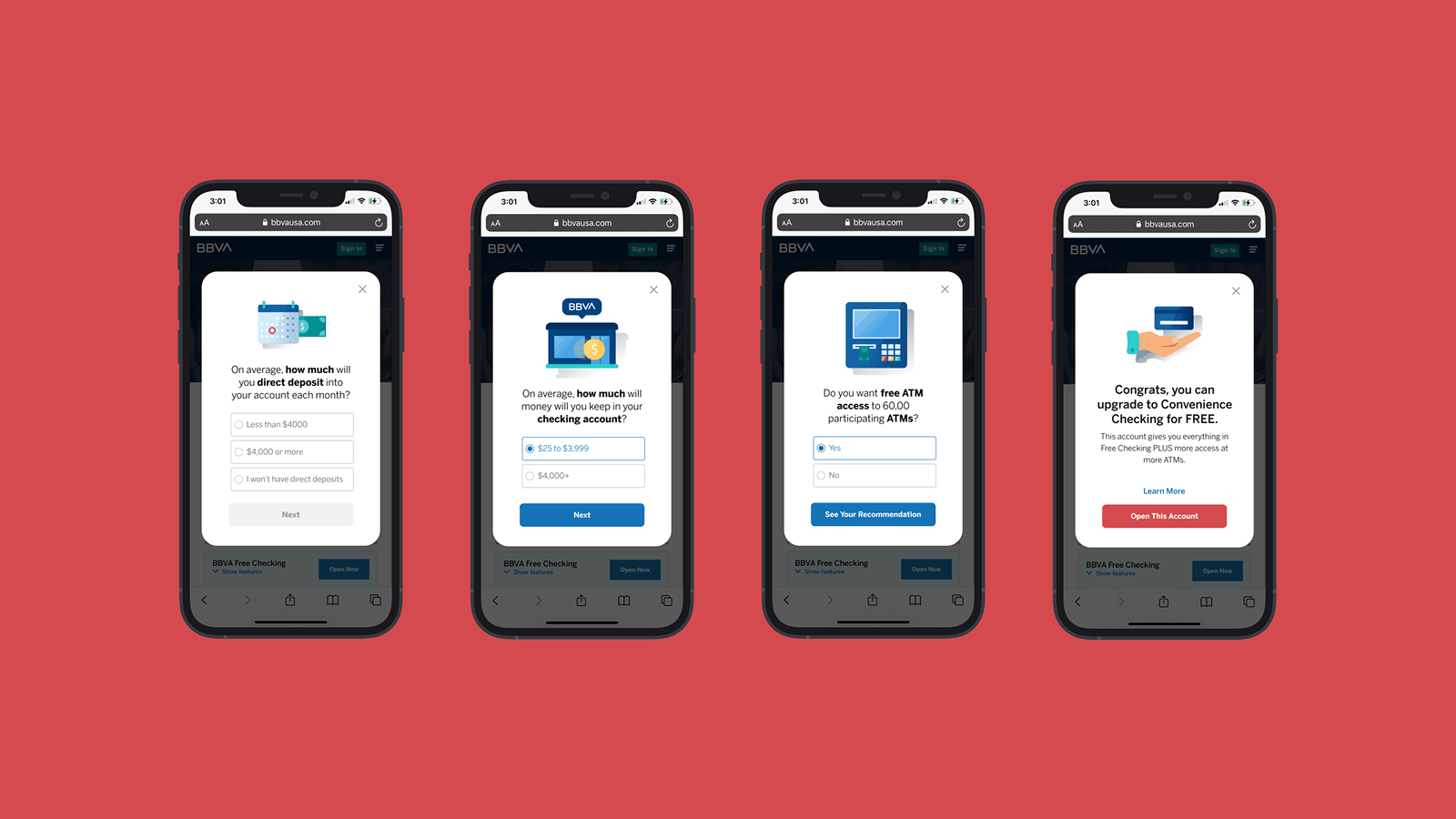
Help me Decide screens
What I Learned
Behavioral economics is a design tool, not manipulation—when used ethically. Our tool worked because customers were genuinely better served by accounts matched to their behavior. We just helped them see it.
Progressive disclosure reduces decision paralysis. Breaking the decision into three simple questions reduced cognitive load dramatically. People want guidance, not complex tradeoffs.
Context matters more than features. Customers don't care about "0.01% APY"—they care about "will this save me money given how I use my bank?" Reframing features as outcomes made value immediately clear.
Best persuasion doesn't feel like persuasion. The tool succeeded because we showed our reasoning, maintained transparency about all options, and let customers override recommendations.
Recognition validates impact beyond internal metrics. Being featured in behavioral economics case studies confirmed we'd applied principles effectively and ethically, advancing the practice itself.